Most strategies don’t fail because they’re poorly designed.
They fail because the organisation required to deliver them was never built to support them.
Every year, leadership teams invest significant time developing strategic plans. Growth targets are set. Priorities are agreed. New initiatives are launched. Yet months later, progress stalls. Teams revert to old behaviours. Competing priorities emerge. Momentum fades.
The issue is rarely the strategy itself.
The issue is often the gap between strategic intent and organisational reality.
Research from McKinsey has consistently shown that organisations with strong organisational health outperform their peers over the long term. Gallup’s workplace studies continue to demonstrate strong links between employee engagement, productivity, profitability, customer loyalty, and retention. The common thread is not strategy alone. It is the ability to align people, leadership, systems, and behaviours around a common direction.
In other words, sustainable performance is created at the intersection of strategy and culture.
Why Leaders Continue to Separate Strategy and Culture
Most organisations treat strategy and culture as separate conversations.
Strategy is discussed in executive planning sessions, annual business reviews, and board meetings.
Culture is often delegated to HR, employee engagement initiatives, leadership programs, or values workshops.
While both areas are important, separating them creates an unintended problem.
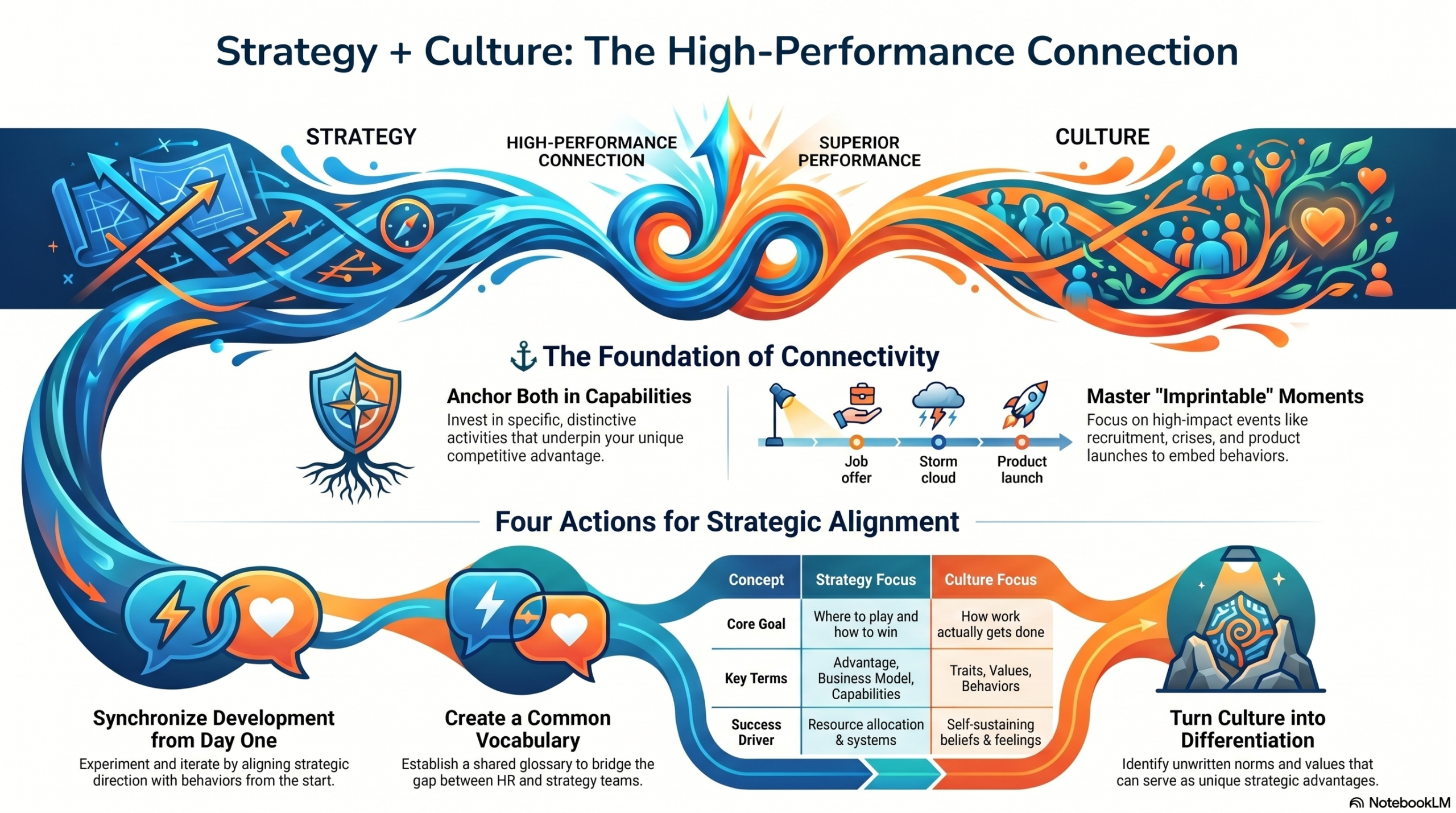
Strategy determines where the organisation wants to go and in what differentiated way.
Culture determines how people behave and what practices must be rigorously applied while trying to get there.
One defines intent.
The other influences execution.
When organisations focus heavily on strategy without considering culture, they often discover that the behaviours needed to deliver their objectives simply do not exist. Likewise, organisations that focus exclusively on culture can create positive working environments without generating meaningful business outcomes.
Neither approach is sufficient on its own.
High-performing organisations understand that strategy and culture operate as a single performance system.
The Hidden Cost of Misalignment
Misalignment between strategy and culture rarely appears as a single major problem.
Instead, it shows up through dozens of smaller issues that gradually undermine performance.
Leadership teams may experience:
- Slow decision-making
- Resistance to change
- Lack of accountability
- Siloed thinking
- Conflicting priorities
- Poor collaboration
- Inconsistent customer experiences
Over time, these issues reduce organisational agility and make strategic execution increasingly difficult.
Consider an organisation pursuing innovation as a strategic priority.
The strategy may clearly state the need for experimentation, new thinking, and continuous improvement.
However, if employees are criticised for mistakes, rewarded only for short-term results, or required to navigate layers of approval before making decisions, innovation is unlikely to flourish.
The strategy says one thing.
The culture reinforces another.
The result is predictable.
The strategy struggles to gain traction.
Culture Is the Operating System of Strategy
Many leaders think of culture as values displayed on office walls or statements published on websites.
In reality, culture is much more practical than that.
Culture is reflected in:
- How decisions are made
- What behaviours are rewarded
- How leaders respond under pressure
- What employees believe is expected of them
- How teams collaborate
- How problems are solved
- What systems are applied
Put simply, culture influences what happens when nobody is reading the strategic plan.
This is why culture can either accelerate strategy or quietly undermine it.
An organisation focused on customer experience, for example, needs a culture that encourages collaboration, accountability, responsiveness, and continuous improvement.
An organisation pursuing operational excellence requires a culture that values consistency, discipline, problem-solving, and ownership.
The strongest cultures reinforce the capabilities that strategy depends upon.
What High-Performing Organisations Do Differently
Research published by Harvard Business Review has highlighted that organisations with aligned cultures and strategies are significantly more effective at executing change and maintaining long-term performance.
These organisations typically focus on building a direct connection between strategic priorities and everyday behaviours.
They recognise that competitive advantage rarely comes from strategy documents alone.
Instead, it emerges through distinctive organisational capabilities.
Examples might include:
- Superior customer experience
- Strong leadership capability
- Operational excellence
- Innovation
- Relationship management
- Workforce capability
Rather than treating culture as a separate initiative, these organisations intentionally develop cultural norms that strengthen the capabilities required to execute their strategy.
This creates alignment between what the organisation wants to achieve and how people behave every day.
What This Means for Australian Organisations
Australian businesses are facing a combination of challenges that place increasing pressure on execution.
Many organisations are dealing with:
- Productivity concerns
- Skills shortages
- Workforce retention issues
- Economic uncertainty
- Increased customer expectations
- Technology-driven change
In this environment, strategic plans alone are not enough.
Organisations need the capability to adapt, collaborate, and execute consistently.
For SMEs in particular, culture often has a greater impact than leaders realise, and often give it scant regard.
Unlike large corporations, smaller organisations have fewer layers, fewer resources, and limited latitude for execution failures.
A leadership team of five or six people can significantly influence organisational culture, positively or negatively.
This means strategy and culture alignment is not simply a people initiative.
It is a crucial business performance issue.
The organisations that navigate uncertainty most effectively will be those that ensure their culture actively supports the outcomes their strategy requires.
Four Actions to Strengthen Strategy and Culture Alignment
1. Define the Capabilities That Drive Competitive Advantage
Start by identifying the capabilities that genuinely differentiate the organisation.
Ask:
- What do customers value most?
- What do we need to be exceptional at?
- What capabilities will support future growth?
These capabilities should become the foundation for both strategy and culture discussions.
2. Build Strategy and Culture Together
Avoid treating culture as something that follows strategy.
When developing strategic priorities, leaders should simultaneously consider:
- Required behaviours
- Leadership expectations
- Decision-making principles
- Workforce implications
This creates stronger alignment from the outset.
3. Focus on Defining Moments
Certain organisational moments have a disproportionate impact on culture.
These include:
- Recruitment
- Onboarding
- Promotions
- Leadership transitions
- Crises
- Customer issues
- Product launches
Employees pay close attention during these moments.
The actions leaders take often have a lasting impact on organisational norms and expectations.
4. Align Systems with Desired Behaviours
Performance reviews, recognition programs, recruitment processes, leadership development, and reward structures all send cultural signals.
If systems reinforce behaviours that contradict strategic priorities, alignment becomes impossible.
Consistency matters.
Strategy and Culture as a Source of Competitive Advantage
Many business leaders view culture as an internal issue.
The most successful organisations view it differently.
They recognise culture as a strategic asset.
Competitors can replicate products.
They can copy pricing models.
They can imitate services.
What they struggle to replicate is a culture that consistently enables superior execution.
When strategy and culture alignment is achieved, organisations become more adaptable, more resilient, and more capable of sustaining performance over time.
That is where real competitive advantage is created.
Final Reflection
The question for leaders is not whether strategy matters. Nor is it whether culture matters.
Both clearly do.
The more important question is whether they are working together.
Many organisations invest heavily in strategic planning while assuming culture will naturally follow. Others invest in culture while struggling to connect it to measurable business outcomes.
High-performing organisations do neither.
They recognise that performance emerges from the connection between strategic intent and organisational behaviour.
It succeeds because the leaders and the people within the business choose to bring it to life every day through clear strategy and conducive culture.