
Your strategy may be clear. Your leadership team may agree on the priorities. Everyone may leave the planning session knowing what needs to happen next.
Yet a few months later, progress has stalled.
Managers are making exceptions. Teams are chasing competing priorities. Decisions that seemed settled are being reopened. People are busy, but the business is not making the progress leaders expected.
The immediate response is often to revisit the strategy, set new targets or push for better execution.
Sometimes that is necessary. But there is another possibility: the strategy is not the main problem. The way the organisation behaves is getting in its way.
For business leaders, recognising the difference matters. Revising a sound strategy will not solve a problem created by inconsistent leadership decisions.
Why organisational culture and strategy execution are connected
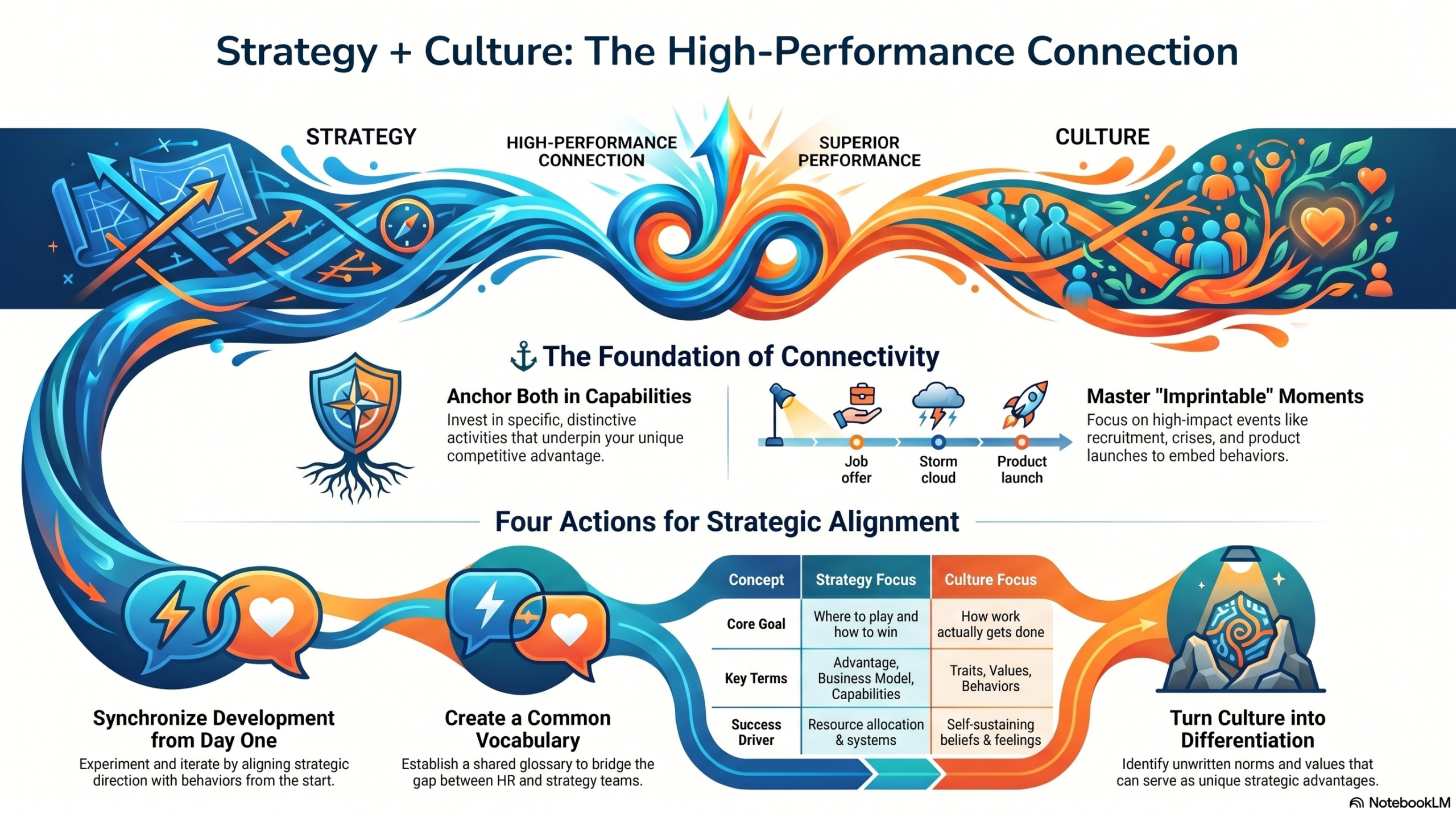
Strategy lays out the logic and defines the choices a business makes about where to compete, how to create value and what it needs to do differently to win in its chosen market.
Execution turns those choices into action.
Between the two sits a set of everyday behaviours. These determine how people prioritise work, respond to problems, make decisions and deal with competing demands.
Consider an Australian manufacturing business that wants to improve profitability by reducing unnecessary customisation. The strategy is straightforward: standardise more products, protect production capacity and improve delivery reliability.
The leadership team agrees.
But the sales manager continues approving exceptions to secure revenue. Production managers are measured on output, so they resist changes that interrupt the schedule. Customer service staff promise delivery dates without checking capacity because they want to keep customers happy.
Each decision may appear reasonable in isolation. Together, they undermine the strategy.
The business does not necessarily have a planning problem. It has a problem with how strategic choices are reinforced through management decisions, performance measures and everyday expectations.
This is where organisational culture becomes commercially significant. Culture influences which behaviours become normal, which decisions are accepted and which problems remain unresolved.
Research by Daniel Denison and Aneil Mishra, published in Organization Science, examined relationships between organisational culture and effectiveness. Their study identified involvement, consistency, adaptability and mission as important cultural traits. The findings support examining culture alongside organisational effectiveness, rather than treating it as a separate people initiative.
The practical implication is that leaders need to look beyond whether employees understand the strategy. They also need to examine what the organisation repeatedly encourages them to do.
What leaders often get wrong
When execution falls short, three responses are particularly tempting.
1. They assume agreement means alignment
A leadership team can agree with a strategy in a meeting without making consistent decisions afterwards.
A manager may support a new direction but continue allocating resources to familiar activities. Another may agree that accountability matters but avoid challenging an influential colleague.
Neither necessarily opposes the strategy. Their everyday behaviour simply reflects existing habits, pressures or incentives.
The distinction is important: agreement is a statement of intent; alignment is demonstrated through decisions and actions.
Leaders should therefore examine what happens after the meeting. Which projects receive resources? Which requests are declined? What work gets postponed when priorities compete?
These decisions provide stronger evidence of alignment than verbal support alone.
2. They tolerate exceptions that become the rule
Most businesses need flexibility. A customer emergency, supply disruption or unexpected opportunity may justify departing from an agreed plan.
The problem arises when exceptions become routine, particularly when senior people are allowed to disregard rules that apply to everyone else.
Employees notice these inconsistencies. They learn that stated priorities are negotiable, accountability depends on the person involved, and challenging established practices may carry more risk than ignoring them.
Over time, the organisation develops two systems: the formal strategy and the informal rules people actually follow.
Leaders do not need to eliminate exceptions. They need to make the reasoning behind them visible, understand their cumulative impact and recognise when repeated exceptions signal a deeper problem.
3. They measure outcomes that compete with the strategy
Performance measures influence where people direct their attention.
A business may want collaboration but reward individual results without considering the cost to other teams. It may prioritise customer experience while measuring managers primarily on cost reduction. It may ask employees to raise problems early but respond defensively when they do.
These contradictions make execution harder.
Harvard Business Review’s article, Context, Conditions, and Culture, argues that cultural effectiveness needs to be considered in relation to factors such as strategy, leadership and organisational design.
That is a useful reminder for leaders: culture cannot be assessed in isolation from the environment in which people work.
If the business wants different behaviour, it needs to examine whether its targets, decision rights, management routines and responses to problems support that behaviour.
What this means for Australian SMEs
For many Australian small and mid-sized businesses, these issues become more visible as the organisation grows.
In a smaller business, the owner or managing director can often resolve problems personally. Decisions are made quickly, relationships are close and informal communication fills gaps in the operating structure.
As the business expands, that approach becomes harder to sustain.
More managers make decisions. Teams become more specialised. Customer demands increase. The founder can no longer oversee every exception or resolve every disagreement.
If the organisation still relies on personal intervention rather than consistent decision-making practices, execution becomes vulnerable.
One department may pursue growth while another protects capacity. Managers may interpret priorities differently. Employees may wait for senior approval because they are uncertain about their authority.
The resulting friction can look like a capability problem, a motivation issue or poor strategy.
Before investing in another training program or rewriting the strategic plan, leaders should establish where the breakdown actually occurs.
Ask whether people lack the skills to execute, lack clarity about what matters, lack the authority to act, or are responding rationally to conflicting expectations. These are different problems and require different interventions.
Four practical actions leaders can take
Changing organisational culture does not start with rewriting the values statement. It starts with examining the behaviours that influence results.
1. Identify where execution breaks down
Choose one important strategic priority that is not progressing as expected.
Trace it from the leadership decision to the work being done. Where do priorities change? Which decisions are delayed? Where do teams make conflicting commitments?
Use specific examples rather than general statements such as “people resist change”.
Measure: Track delivery against the priority, recurring exceptions and unresolved decisions.
2. Examine the decisions leaders make under pressure
Review recent situations where leaders faced competing demands.
Did they protect the agreed priority, or abandon it as soon as another issue became urgent? Were exceptions explained? Did the leadership team apply consistent standards?
The objective is not to criticise every difficult decision. It is to identify recurring patterns that make strategic execution unpredictable.
Measure: Review significant exceptions and their reasons during monthly leadership meetings.
3. Align accountability with the intended outcome
Check whether individual and team measures reinforce the same strategic priorities.
If customer experience depends on cooperation between sales, operations and service, individual targets should not encourage those functions to optimise their own results at the expense of the overall outcome.
Clarify who owns each priority, who has authority to make decisions and how cross-functional conflicts will be resolved.
Measure: Review progress against shared outcomes, not just departmental targets.
4. Make leadership behaviour part of performance reviews
Leaders should be accountable for how results are achieved, not only whether targets are met.
A manager who achieves short-term numbers by creating avoidable rework, suppressing concerns or undermining another team may be damaging longer-term performance.
Discuss the behaviours that enabled or obstructed results during regular performance reviews. Address inconsistencies directly, including those demonstrated by senior leaders.
Measure: Include evidence of collaboration, follow-through, sound decision-making and early escalation in leadership reviews where relevant.
The real test is what happens after the strategy meeting
A strategy meeting can create clarity. It cannot, by itself, establish how an organisation will behave when the pressure is on.
That is revealed later: when a major customer requests an exception, when two departments compete for resources, when a manager misses a target, or when a difficult problem needs to be raised.
These moments tell employees what leadership genuinely values.
For Australian business leaders, the important question is not simply whether the strategy is right. It is whether the organisation’s decisions, incentives and management practices make that strategy achievable.
If execution repeatedly breaks down, resist the temptation to assume that the plan needs another revision.
Look first at the behaviours the business rewards, the inconsistencies it tolerates and the decisions it leaves unresolved.
The strategy describes the direction. Leadership behaviour ensures progress, and aligned systems determine whether the organisation consistently moves forward.
If your business has a clear strategy but results are not following, it may be worth examining the gap between what leadership intends and what the organisation actually does. Chalon Performance Consulting helps SME leaders investigate organisational performance issues and identify practical ways to improve execution.
Start by asking your leadership team one question: What do our everyday decisions teach people about which priorities really matter?