The Misunderstood Equation Behind SME Performance
Most SME leaders don’t wake up thinking, “We need to fix our culture.”
They think:
- “We need better resources.”
- “We need more skilled people.”
- “We need to execute faster.”
So they invest in capability—training, tools, technology, new staff, and yet… performance still plateaus.
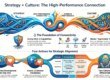
This is where the misunderstanding begins. World-class performance isn’t built on capability alone. It sits on two interdependent forces: Capability and Culture. Most SMEs are only working on one.
Capability Is Visible. Culture Is Not.
Capability feels tangible. You can measure it, improve it, and justify the spend.
- Skills can be trained
- Onboarding can be optimised
- Equipment can be upgraded
Culture, on the other hand, is harder to pin down.
It shows up in:
- How decisions are made
- How leaders behave under pressure
- What people actually prioritise (especially when no one is watching)
So naturally, SMEs gravitate toward capability. It feels safer. More controllable.
But here’s the problem:
👉 Capability without culture rarely translates into consistent performance.
The Default Trap SMEs Fall Into
We see this pattern repeatedly.
An SME identifies a performance gap and responds by:
- Hiring more experienced talent
- Investing in training programs
- Introducing new tools or frameworks
Short-term improvement follows. Then… regression.
Why?
Because the underlying culture hasn’t shifted.
- Accountability is inconsistent
- Priorities compete
- Leadership behaviours contradict expectations
The result? Capability improvements never fully land.
The Hidden Tension Between the Two
Capability and culture don’t operate independently. They either reinforce each other—or cancel each other out.
Think about it this way:
- You can train a team to be highly capable
- But if the culture tolerates mediocrity, performance drops
- You can build strong systems
- But if decision-making is slow or political, execution stalls
This is the gap most SMEs don’t see.
👉 It’s not that capability isn’t working. It’s that culture is quietly overriding it.
Why Culture Is the Multiplier (Not the Soft Stuff)
There’s a common misconception that culture is “soft” and secondary.
In reality, it’s a performance multiplier.
A strong culture:
- Reinforces standards
- Drives consistency
- Enables faster decisions
- Sustains performance under pressure
Without it, capability becomes fragile.
You end up with:
- High potential teams underperforming
- Strategies that never fully execute
- Leaders constantly “pushing uphill”
What High-Performing SMEs Do Differently
The SMEs that break through don’t choose between capability and culture.
They build both—deliberately.
They:
- Align leadership behaviour with expectations
- Create clarity on what “good performance” actually looks like
- Reinforce accountability at every level
- Treat culture as something they actively design—not something that “just happens”
Most importantly, they understand this:
👉 Capability drives what your business can do.
Culture determines what it actually does.
Bridging the Gap
If performance feels inconsistent or harder than it should be, it’s rarely a capability issue alone.
It’s usually a misalignment between:
- What the business is trying to build
- And how people are actually operating
The fix isn’t more tools or more training.
It’s stepping back and asking:
- Are we building capability in isolation?
- What behaviours are we tolerating?
- Is our culture reinforcing—or resisting—our strategy?
Most SMEs don’t fail because they lack capability. They stall because they misunderstand the role of culture. And until both are working together, achieving consistent performance will always feel harder than it should.